Axios, Supply Chains, and a Claude Leak
If you still think npm install is a harmless ritual, this week was a reality check. What looks like dependency management is, in practice, executing third-party code with full trust inside your environment.
Two incidents collided almost perfectly: a compromised release of the widely used Axios package, and an accidental source leak involving Claude Code. Different root causes — same lesson.
1. When a Trusted Package Turns Hostile
Axios is one of the most widely used HTTP clients in the JavaScript ecosystem. That’s exactly what made it such a valuable target.
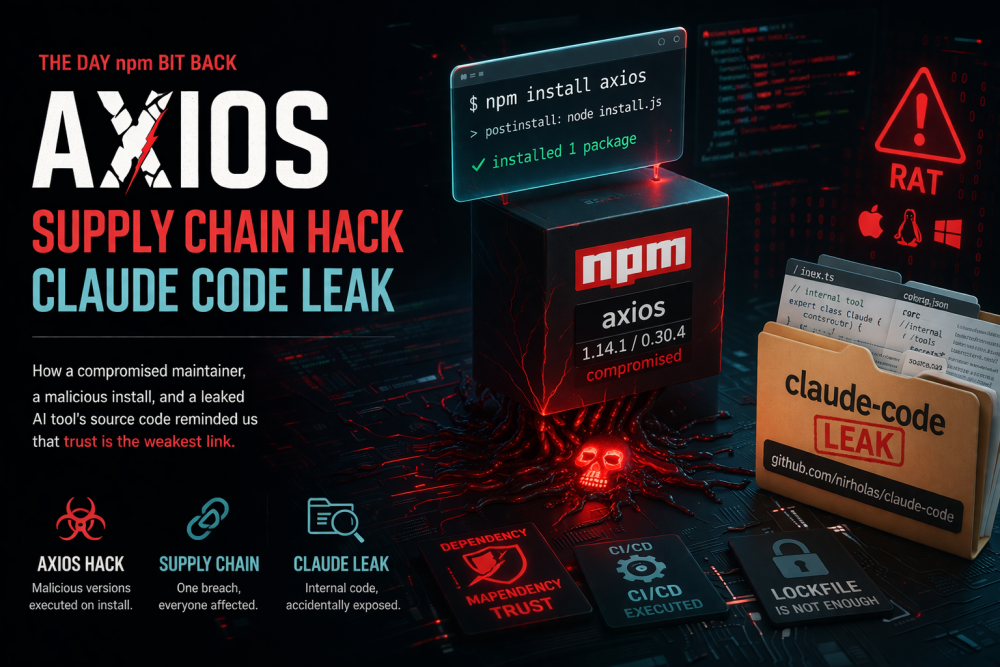
Attackers gained access to a maintainer account and published malicious versions that appeared legitimate. These versions included hidden behavior that executed during installation — before your app even started.
npm install axiosThat single command was enough. No imports, no execution paths, no runtime triggers. Just installing dependencies triggered the payload.
- Malicious versions were live briefly
- CI pipelines executed them automatically
- Payloads cleaned up after themselves
This is the purest form of a supply chain attack: compromise a trusted node, and every downstream system inherits the risk.
2. The Real Problem: Humans in the Loop
Traditional advice focuses on avoiding suspicious packages. But this attack didn’t rely on deception — it relied on trust.
The question is no longer “Is this library safe?”
It’s “Is everyone who can publish to it safe?”
Maintainer accounts are now critical infrastructure. A single compromised credential can ripple across thousands of applications.
3. Meanwhile: The Claude Code Leak
As if that wasn’t enough, another issue surfaced: an apparent leak of internal artifacts via an npm package.
Repository: github.com/nirholas/claude-code
The likely cause? A packaging mistake — unintended files included in a published artifact. Think source maps, internal modules, or entire directories that were never meant to leave the development environment.
It’s the classic failure mode:
- Build pipeline includes too much
- No strict allowlist for published files
- No verification of final package contents
The result is less dramatic than malware, but just as dangerous in the long run: intellectual property exposure and potential security insights for attackers.
4. Why This Keeps Happening
The JavaScript ecosystem optimizes for speed and convenience:
- Deep dependency trees
- Automated installs in CI/CD
- Implicit trust in maintainers
- Minimal verification at install time
In other words, we’ve built a system where executing untrusted code is the default.
5. Practical Defenses
Lock Down Dependencies
- Commit and enforce lockfiles
- Avoid automatic dependency upgrades in CI
- Use deterministic builds
Harden CI/CD
- Run installs in sandboxed environments
- Limit network access during builds
- Use ephemeral credentials
Verify What You Ship
- Audit package contents before publishing
- Use
filesallowlists in package.json - Scan for secrets and internal artifacts
Reduce Trust Radius
- Vendor critical dependencies when possible
- Prefer fewer, well-audited libraries
- Monitor dependency changes actively
6. A New Mental Model
It’s time to stop thinking of dependencies as static libraries and start treating them as dynamic, potentially hostile inputs.
import something from "the-internet"That line has always been powerful. Now it’s also a liability.